Sep 19, 2026Country Guides
Vietnam Customs Data (2026): Tracing Buyers Across Trade and Shipping Records
Vietnam pairs trade declarations with shipping movements on Customsdatas. A HOT source for verifying buyers and timing outreach.
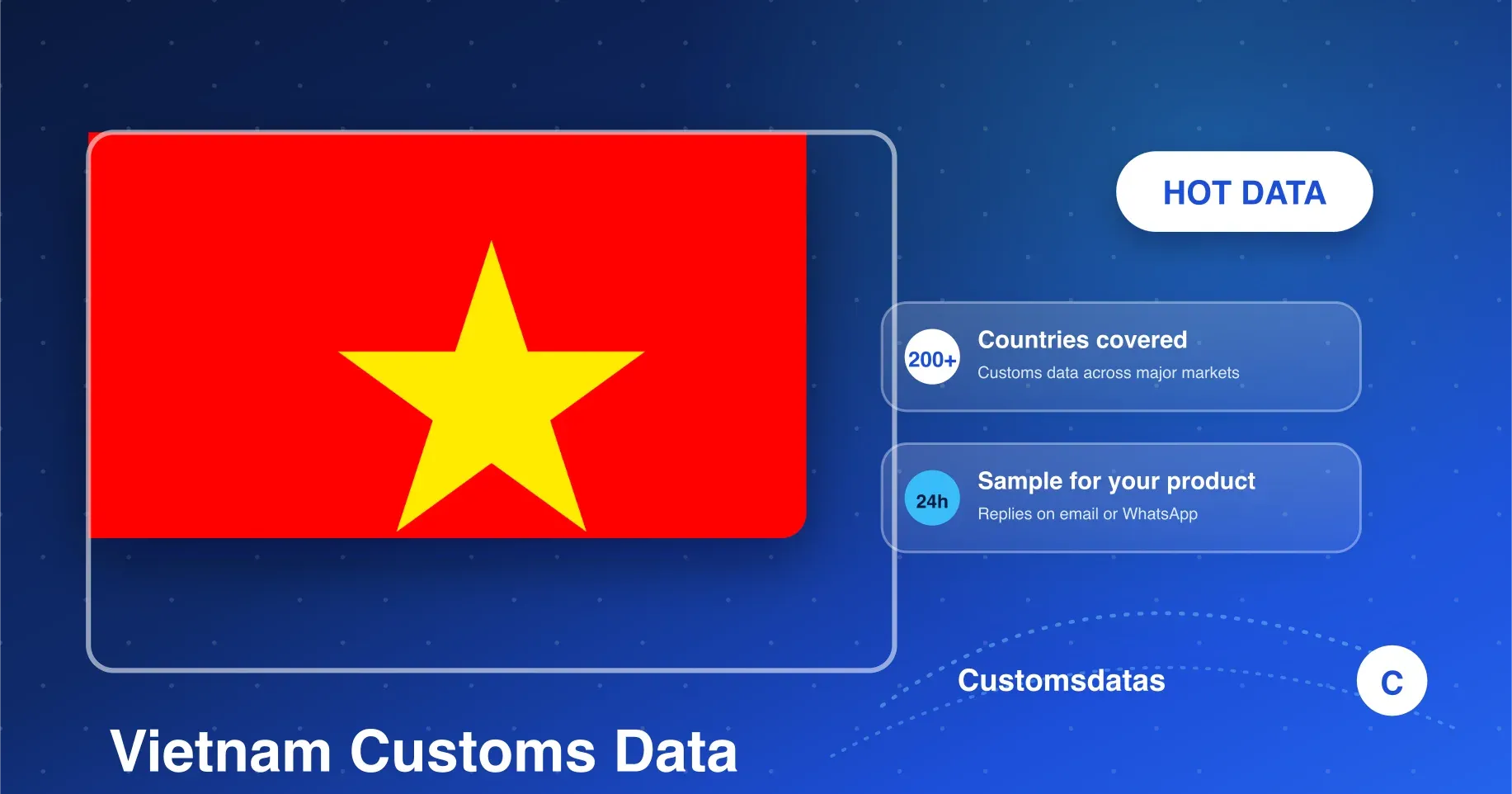
Vietnam is one of the busiest manufacturing and sourcing economies in Asia, and on Customsdatas it is flagged as a HOT source with two record types running side by side: trade data and shipping data. For anyone buying from or selling into Vietnam, that pairing is the difference between knowing a transaction happened and understanding how the goods actually move.
Most data sources give you one side of that picture. Vietnam gives you both, which opens up verification workflows that single-source markets simply cannot support.
The trade layer: declarations with full trading parties
Vietnamese trade data captures the declaration layer — the commercial records naming who stands on each side of a transaction, what was declared, and at what scale. That is the part of the dataset built for answering who is really buying and selling, and the exact searchable fields for your product line are best confirmed on a sample run.
For exporters selling into Vietnam, this layer is where the buyer research starts: companies whose declarations match your product category, with the trade rhythm that tells you whether the account is worth pursuing. For importers sourcing from Vietnam, it reads the other direction — supplier histories, specialization, and consistency.
The shipping layer: the movement behind the paperwork
Shipping data follows the cargo: how goods physically move between Vietnam and its trading partners. Where a trade record proves the relationship, the shipping layer shows whether it is live right now — recent movements, recurring flows, and the rhythm of a trading relationship.
Read the two together and the verification workflow almost writes itself: the trade record says who declared the shipment; the shipping record confirms the goods are actually moving on that route. A buyer with declarations but no recent movement may have switched suppliers; a buyer with steady movements and no change in declarations is an active account in every sense.
Buyer tip: use the shipping layer to time your outreach. A Vietnamese importer whose inbound flow has just resumed after a quiet stretch is far more receptive than one mid-cycle with an incumbent supplier.
Why the combination matters for competitor tracking
Vietnam's manufacturing base means many categories have dense, fast-moving supplier networks — textiles, electronics assembly, furniture, footwear. In that environment, knowing that a competitor shipped to a buyer last month is current-intelligence, not history.
The competitor workflow on Customsdatas runs on the same record base: identify which Vietnamese buyers your rivals serve, how often the shipments move, and where the volumes concentrate. Those buyers already buy your category — the pitch is a comparison, not an education.
The AI Buyer Discovery Suite adds the ranking layer on top: six modules covering buyer identification, scoring by purchase activity and opportunity value, market recommendation, similar-buyer discovery, outreach lists with emails and WhatsApp contacts, and competitor buyer detection. For a market as active as Vietnam, scoring first is what keeps the outreach list short and warm.
A practical first week on Vietnamese data
Day one: search your product line and shortlist the Vietnamese counterparties that appear. Day two: rank them by trade frequency and separate steady accounts from spot buyers. Day three: overlay the shipping layer and mark which accounts have live movements right now.
Day four: check the competitor module for overlap — which of your targets are already served by rivals you know. Day five: build the outreach list with verified contacts and start with the accounts whose timing looks best. One week, one market, one working pipeline.
Buyer tip: do not skip the frequency ranking. In a market this active, the top of an unsorted list is just noise; the top of a frequency-ranked list is a customer forecast.
Reading rhythm in a dense market
Active markets move to a calendar. Production cycles, holiday periods and port congestion all leave fingerprints in the shipping layer: flows that pause, bunch up, or shift between routes. Reading two or three periods side by side tells you what a normal Vietnamese trading rhythm looks like for your category — and, more usefully, what an abnormal one looks like.
That baseline is what turns alerts into opportunities. When a buyer's usual rhythm breaks — a gap that does not match the season, a sudden new destination, volumes arriving through a different lane — the records show it, and that is exactly the moment a well-timed introduction gets answered.
Common mistakes in high-volume markets
The first mistake is chasing only the giants. Vietnam's biggest importers are the most visible names in the records, but they are also the hardest to move and the slowest to answer. The mid-tier importers with steady recurrence and growing volumes are where new suppliers actually get adopted.
The second is reading declarations without the movement layer. A clean declaration history with no recent shipping activity is a warning sign, not a green light — the pairing exists precisely so you do not build a list on paperwork alone. And the third is writing to everyone at once: in a market this dense, a scored short list of twenty buyers beats a cold blast of two hundred.
Getting started with a sample
The fastest way to judge the fit is to see your own category in the data. Send your product name or HS code through the inquiry form and the Customsdatas team replies within 24 hours with sample Vietnamese records — buyers, movements, and the fields behind them.
Frequently Asked Questions
What record types does Vietnam have on Customsdatas?
Vietnam carries both trade data and shipping data — the declaration layer covering who is trading what and at what scale, plus the cargo movements behind them. The pairing is why Vietnam is flagged HOT.
Can I verify a Vietnamese supplier before ordering?
Yes. The trade layer shows the supplier's declaration history and consistency; the shipping layer shows whether cargo is actually moving now. Together they answer the reliability question with records instead of references.
How do I see samples for my HS code?
Request a free sample through the inquiry form or WhatsApp. The team replies within 24 hours (Mon-Sat, GMT+8) with records matched to your product line.
Ready to trace Vietnamese buyers and movements in your category? Request a free sample from Customsdatas and see the HOT pairing of trade and shipping records on your own product within 24 hours.