Sep 18, 2026Lead Generation
How to Monitor Competitors' Shipments and Win Their Buyers (Ethically)
Your competitors' shipment records are public. Here's how to see who they supply, how often, and how to position your offer to those exact buyers.
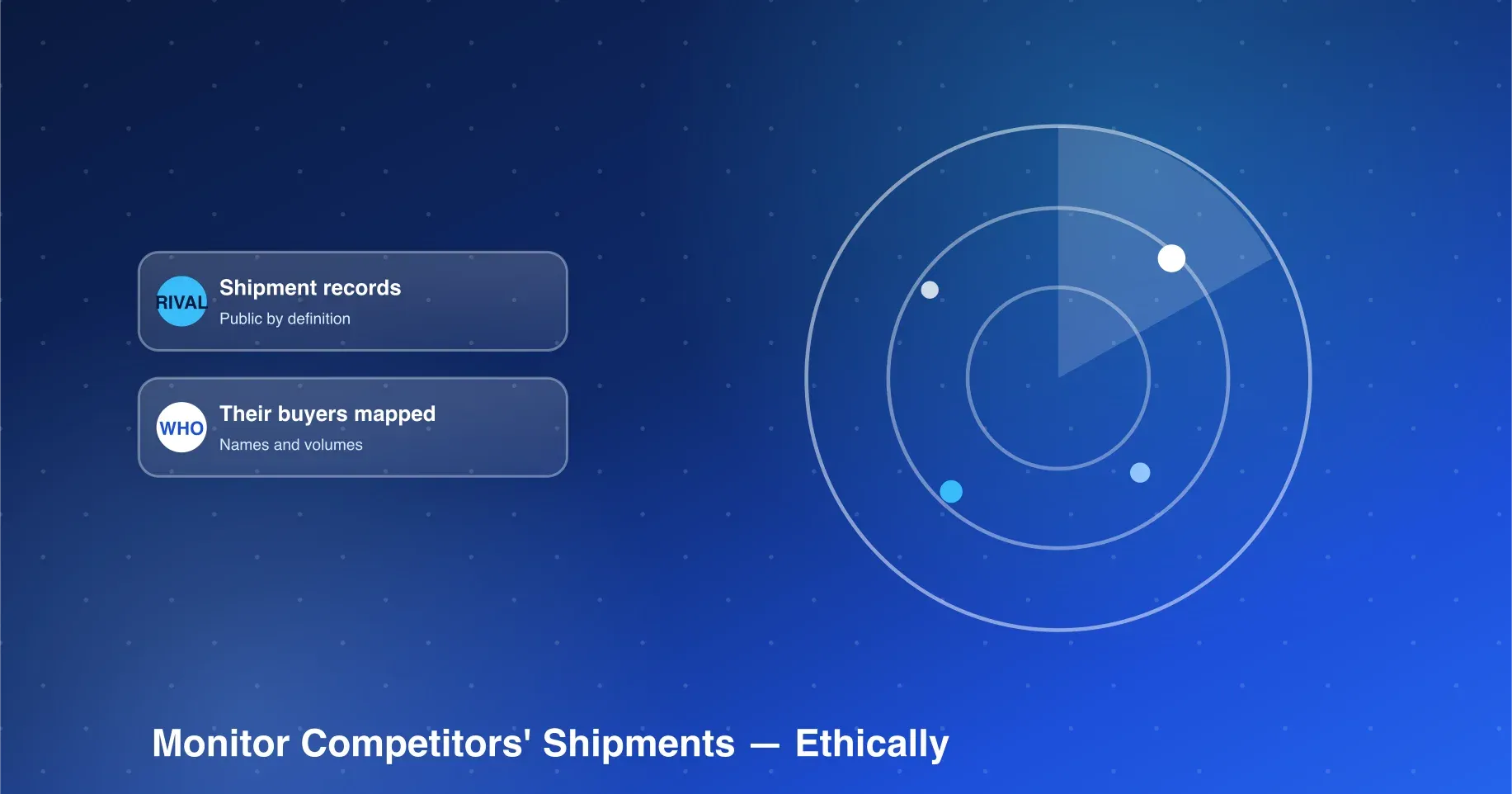
Most exporters spend their weeks guessing which importers might buy what they sell, while a rival down the road seems to know exactly who to call. Here is the part most exporters miss: every shipment your competitor sends is a public record, and that record names the buyer waiting on the other end.
These records are public facts, not secrets
Customs filings are not gossip or guesswork. When goods cross a border, the shipment is declared to customs, and in many markets that declaration becomes a searchable record: who shipped it, who received it, what the goods were, what quantity moved and what value was declared. Customsdatas indexes 10 billion+ of these shipment records across 200+ countries and regions, searchable by product, HS code, buyer, supplier or country.
But if the data sits in public view, why do so many exporters behave as if their competitor's customer list were locked in a safe? Because it is not. The list is updated shipment by shipment, and there is a good chance your rival is already reading it.
What Do the Records Actually Reveal?
Start with the names. In a bill of lading record, the shipper field identifies the exporting supplier and the consignee field identifies the company that received the goods. Search your competitor as a shipper, and every consignee attached to those records becomes a name on your list: real buyers, with real orders behind them.
Frequency and volume come next. A buyer that appears in the records month after month is a repeat account; one that shows up twice a year is a spot buyer. The quantity and value fields add scale: rising volumes point to an account that is growing, while shrinking ones point to a buyer who may welcome a better offer.
The gaps deserve the closest attention. When a buyer's records show the same shipper for years and then a different name appears, that buyer has switched suppliers — and the quiet stretch around a switch is often when they are most open to new quotes.
Buyer tip: choose two or three competitors that match your exact HS code and follow them for a full quarter before you change anything about your outreach. One shipment proves nothing; a pattern needs several records before it means anything at all.
Turn Competitor Intelligence Into a Legitimate Play
Time Your Offer to the Replenishment Cycle
Timing beats clever wording. If the records show a buyer ordering like clockwork every month or two, the useful moment to appear is shortly before the next order falls due, when budgets and reorder decisions are fresh. You are not guessing when to write; the shipment history tells you when this buyer actually buys.
Lead With Your Differentiation
Angle matters just as much as timing. The records tell you what the buyer already imports, in what quantities and from which markets, so lead with what you do differently: a broader product range, faster lead times, more flexible order sizes, better documentation. Buyers do not switch because a new supplier exists; they switch because the move is worth their while.
Compete With Decency: The Red Lines
Knowing who a competitor supplies does not entitle you to use that knowledge badly. Do not bad-mouth the incumbent — buyers can smell desperation, and claims you cannot support will burn you later. Do not impersonate anyone, and do not trade on a rival's name to force a door open. And do not harass: one relevant, honest introduction is outreach; five chasers in a week is spam.
That is what the word 'ethically' in the title is doing: customs records are open to everyone, and the edge comes from how honestly and how thoughtfully you act on them. Clean methods also protect the asset that matters most in export sales — your reputation.
Let the Tools Do the Watching
Doing this by hand across dozens of buyers gets tiring fast. The AI Buyer Discovery Suite from Customsdatas runs six modules — identify, score, recommend, similar, outreach and competitor — and it works from bill of lading records, HS codes and trade frequency. The competitor module does precisely what this article describes: it detects which buyers your competitors supply.
Scoring then ranks the resulting buyers by purchase activity and opportunity value, and the outreach module turns the shortlist into contact lists with emails and WhatsApp details. If you would rather have the analysis handled for you, the Trade Data API and custom reports service delivers market entry, competitor and product reports, and can pipe the data straight into your own systems.
Your first 30 days, then a steady rhythm
Days 1 to 10: fix your product's HS code, pull the shipment history of two or three competitors, and build a working list of their buyers with rough volumes and frequency. Days 11 to 20: trim that list to accounts that fit what you actually produce, find contacts through the buyer database, and draft a first message built on your differentiation.
Days 21 to 30: send the first round of introductions, timed where you can to each buyer's replenishment window, and log who replies. After that, put a repeating slot on the calendar — an hour a week is enough — to refresh the records, spot new gaps and catch the next supplier switch early.
Frequently Asked Questions
Is it legal to look at competitors' shipment data?
The records themselves are public: shipments are declared to customs, and that declaration is what trade data platforms license and make searchable. So reading them is not the problem — the way you use them is what has to stay clean. Contact buyers honestly, represent yourself accurately, respect how they prefer to be contacted, and compete on merit. Open data plus decent behavior is the whole formula.
I found a buyer name, now what?
Treat the name as the start of qualification, not the finish. Study that buyer's full import history — products, origins, frequency — to see whether the account fits your business, then move to contact details. The Verified Global Buyer Database holds 50 million+ buyer records with emails and social channels, so you can reach a real person instead of a generic inbox.
How Many Competitors Should I Follow?
Start small: two or three rivals inside your exact HS code give you more signal than a vague watch on ten. Once the routine feels natural, widen it — coverage spans 200+ countries and regions, so the same method stretches to new markets whenever you decide to push there.
Ready to see who your competitors really supply? Request a free sample from Customsdatas — send us your product and HS code, and we will pull real shipment records for your market and reply within 24 hours, Mon-Sat (GMT+8). That first list is the shortest path from watching to winning.