Country Guides
Ivory Coast Customs Data (2026): Resolve HS and Brand Conflicts Before Exporter Outreach
A field-level conflict register for Ivory Coast trade records that tests HS, brand and direction disagreements before exporter research.
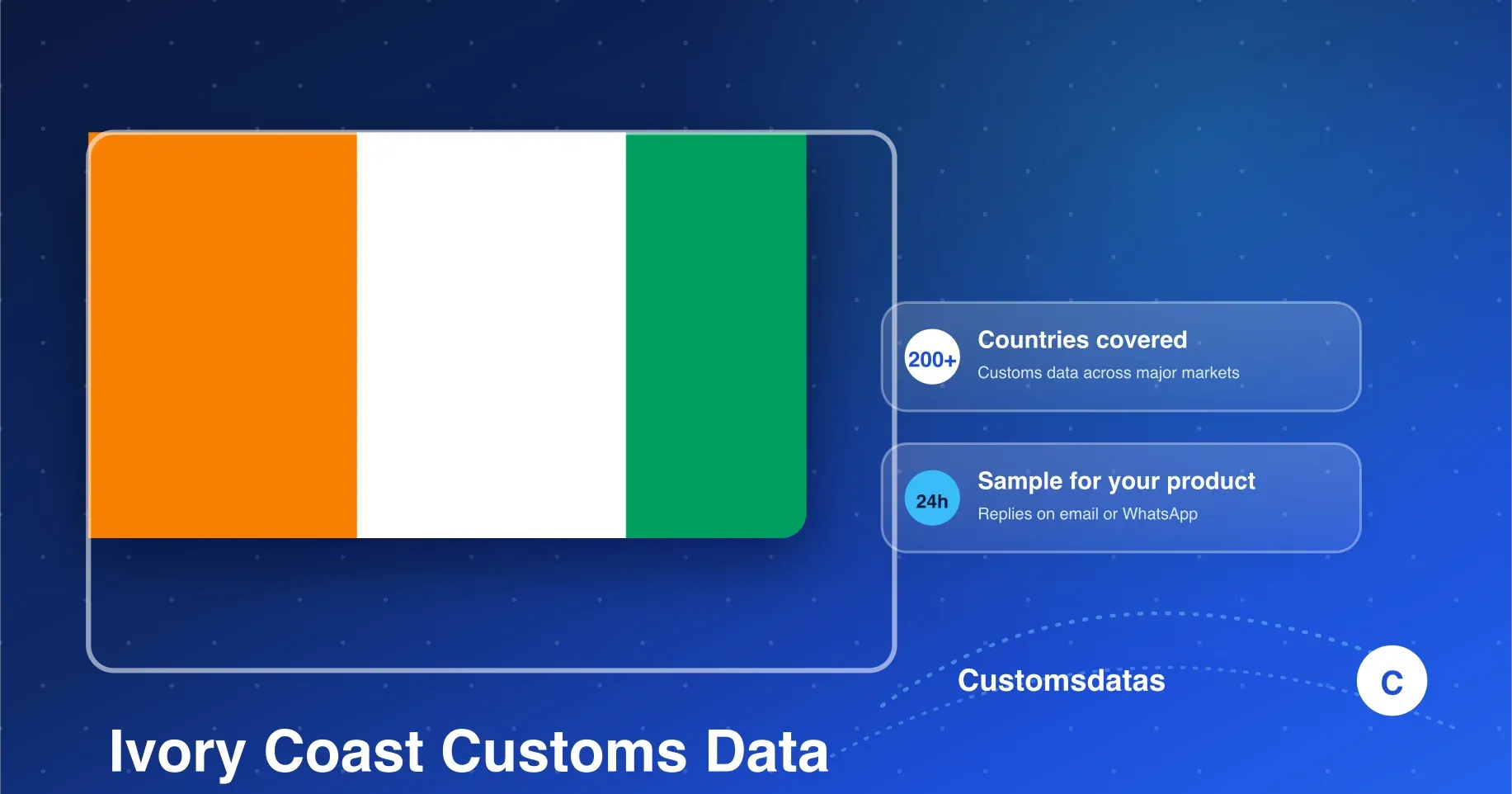
Ivory Coast customs data can help researchers organize trade evidence before contacting potential exporters, but the starting point should be a field inventory rather than a promise about individual records. The Customsdatas country matrix lists trade data and identifies seven fields in both import and export views: exporters, product descriptions, HS codes, quantity, weight, value, and brand. It also marks English as the profile language and indicates air availability and updates. These are profile-level attributes. They do not establish that every record contains all seven fields, that every shipment uses the same measurement units, or that every displayed company is an active supplier.
A practical way to use this profile is to build a conflict register. Instead of hiding contradictions between classification, brand, description, and direction, record them as research tasks. The outcome should be a smaller, better explained shortlist that a commercial team can verify independently.
Turn the Seven-Field Inventory Into a Coverage Experiment
Begin with a deliberately limited Ivory Coast search. Record the query, trade direction, HS scope, period, date of retrieval, and any source record reference. For each returned row, mark whether each of the seven listed fields is populated, blank, or unclear. Keep the original field labels and values in an untouched worksheet. Put cleaned spellings and interpretations in separate columns so a reviewer can trace any change.
Do not select only records that look complete. Include a few ambiguous results if they occur, because missing fields often determine whether a proposed analysis is feasible. Calculate a simple completeness count for the sample, not a national coverage percentage. The country matrix confirms the fields offered in the profile; only an actual query can show how consistently those fields appear for a specific product and period.
Build a Côte d’Ivoire Two-Lane Discrepancy Ledger
Both directions in the Ivory Coast matrix list exporters, product descriptions, HS codes, quantity, weight, value, and brand. That symmetry permits a controlled comparison of field names, but it does not mean the underlying populations or reporting rules are interchangeable. Store import observations and export observations on separate tabs. Apply the same product scope and comparable periods before investigating differences.
On the import tab, ask what each exporter field actually identifies in the displayed record and whether the description is sufficiently specific. On the export tab, repeat the same checks without presuming that a company appearing in both tabs represents one continuous transaction. A matching name can be a lead for further investigation, not proof of a relationship. Preserve spelling variants and mark unresolved identity matches. A directional discrepancy should become an item in the conflict register, not something silently averaged away.
Triage HS, Description, and Brand Disagreements
HS code, product description, and brand are three distinct clues. A code groups goods by classification, a description uses source language to describe them, and a brand can suggest commercial identity. The matrix lists all three for both directions, which makes a sample-level consistency audit reasonable. It does not establish that any two clues will agree. Build a review column for broad descriptions under narrow codes, missing brands, and repeated brand labels attached to different product descriptions.
Use an explicit resolution status: aligned, needs source review, or insufficient evidence. For each unresolved case, quote the original text and retain the record reference. Avoid filling a missing brand from a company name or translating a vague description into a precise product claim. If the interface displays English labels, do not assume that every underlying source description is in English; inspect the text actually returned. This prevents confident but unsupported product matching from entering an outreach list.
Prevent Unit Drift From Becoming a Supplier Ranking
The listed quantity, weight, and value fields invite comparison, yet their presence says nothing about universal units or valuation bases. Inspect the unit beside quantity, the weight basis, and the value context before computing ratios. Keep rows with incompatible units out of the same calculation. If a unit is not visible, record the gap rather than converting it by guesswork.
A value-per-unit figure can be useful as a diagnostic inside a tightly defined subset. It is not a verified quotation or a measure of supplier quality. Flag extreme ratios and examine whether a broad HS group contains different goods, whether a quantity unit changed, or whether a row is aggregated. Compare like with like only after these checks. The conflict register should preserve rejected calculations and reasons, so a later reviewer can reproduce why an apparently attractive record was not used.
Record Mode Proof and Retrieval Chronology for Ivory Coast
The Ivory Coast profile indicates air availability and updates. Those flags are useful prompts for inspection, not evidence that a particular shipment moved by air or that every period refreshes regularly. If the interface exposes a mode filter, run a small controlled comparison with and without it. Record the actual mode value on each selected row. When the row has no mode evidence, leave it unknown rather than labeling it an air shipment.
For freshness, separate the transaction date, the date a result became visible, and your own retrieval date. Save the query parameters and sample identifiers so the same search can be repeated. A later result count that differs may reflect filters, coverage, or newly visible records; it does not automatically prove a change in market demand. Treat a refresh indicator as a reason to verify chronology, never as a substitute for it.
Convert Conflicts Into a Defensible Exporter Brief
Once the sample has been reviewed, prepare a one-page brief per candidate rather than a bulk list of names. Include the observed exporter label, the product clues that support relevance, the direction and period, the original source reference, and any unresolved brand, classification, or measurement conflicts. Assign a next check to every uncertainty. A candidate with fewer records but clear provenance may be more useful than one with a large unexplained value.
Before outreach, verify the business's current identity, role, and contact channel through independent sources. A customs record cannot certify present capacity, commercial willingness, pricing, or regulatory compliance. Keep the brief's conclusion proportionate to the evidence: a research lead with traceable reasons, not an endorsement. This makes the Ivory Coast workflow reusable even when later samples contradict the first shortlist.
Frequently Asked Questions
Does the Ivory Coast profile guarantee seven populated fields on every record?
No. The source matrix lists seven fields for import and export views, but record-level completeness must be checked in a sample. Preserve blanks and uncertain values rather than filling them with assumptions.
Can I combine import and export records to rank exporters immediately?
Not safely. Confirm compatible dates, product scope, field meanings, and company identities first. Keep the two directions separate until the comparison can be defended from observed records.
Does an air or update flag prove recent air shipments?
No. The flags indicate capabilities to investigate. Confirm actual mode labels and transaction dates in returned records before making a shipment-specific or freshness claim.
Request a free Customsdatas consultation to review an Ivory Coast sample, test field consistency, and turn unresolved trade-data conflicts into a practical exporter research plan.