Sep 19, 2026Country Guides
Costa Rica Customs Data (2026): Which Shipment Fields You Can Search
Costa Rica carries HOT-flagged trade data and statistics with air freight coverage. A field-by-field guide to what you can search in each direction.
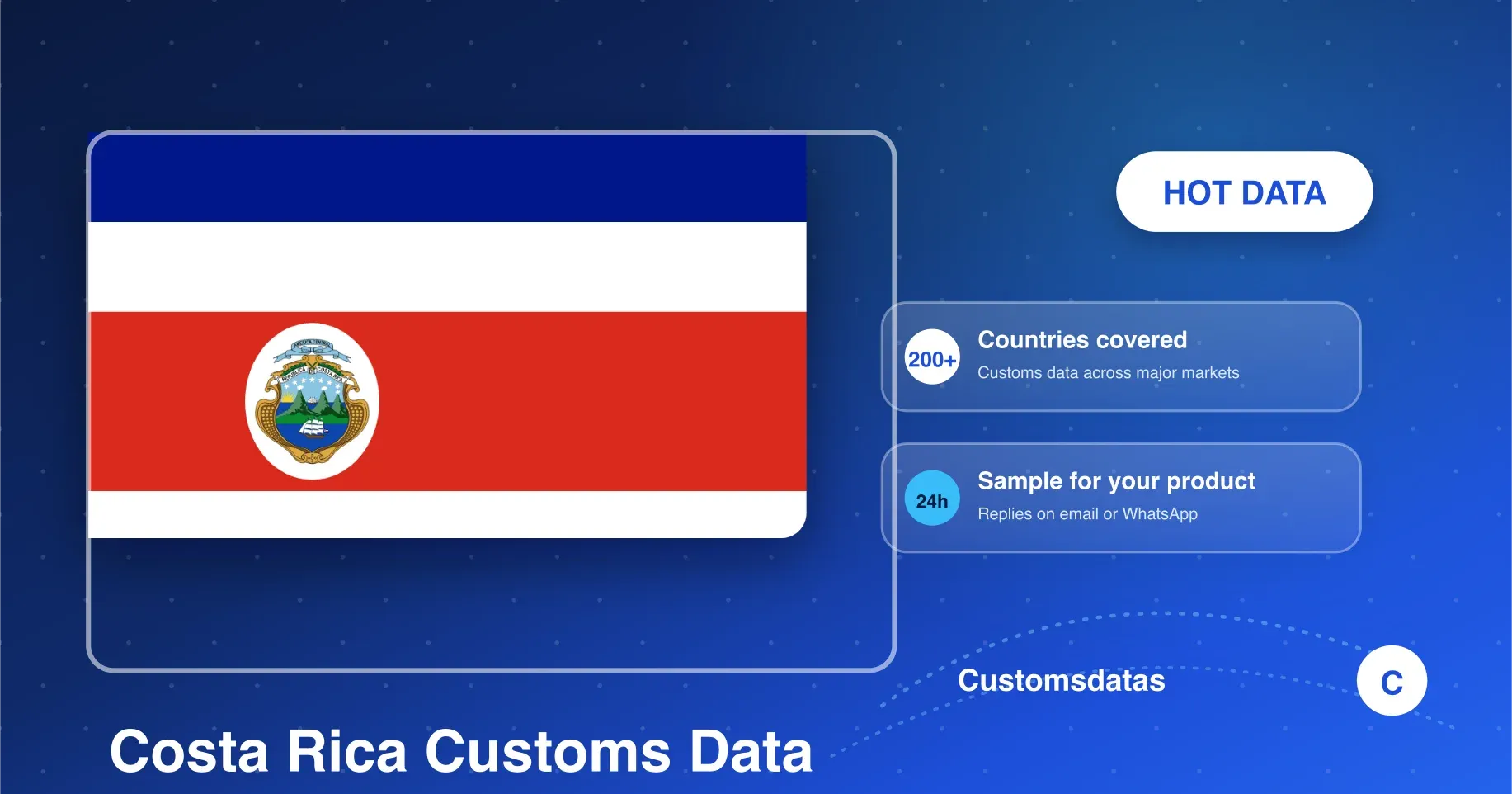
Costa Rica occupies a small but steady corner of Latin American trade, and on Customsdatas it carries a HOT flag: trade data plus statistical coverage, refreshed regularly, with air freight records included. For sellers targeting Central American buyers, it is one of the more complete data packages in the region.
This guide walks through the searchable fields country by country and direction by direction, because Costa Rica's records are not symmetric: what you can search on an import declaration differs from what you can search on an export declaration. Knowing that asymmetry before you build a target list saves a lot of wasted filtering.
Import records: the buyer-side view
On the import side, Costa Rican records let you search by exporter, HS code, quantity, weight, value and brand. That combination is built for supplier discovery: you can take your product's HS code, pull every import declaration that mentions it, and read off exactly which overseas exporters are serving the Costa Rican market today.
Brand search is the quietly powerful one here. If your product category is brand-sensitive — electronics, consumables, machinery parts — brand-level filtering shows you which international brands already have distribution in Costa Rica, and which local importers handle them. Those importers are proven category buyers with shelf space and logistics already in place.
Buyer tip: run the HS code search first, then check the brand field on the results. If your competitors' brands keep appearing with the same importer, that importer is your warmest possible entry into the market.
Export records: the supplier-side view
The export side flips the emphasis: records there are searchable by product description, HS code, quantity, weight, value and brand. Product description is the key addition — Costa Rican export declarations describe the goods in words, which makes it easier to spot niche producers that never show up in code-only searches.
For importers elsewhere in the world, this side of the database answers a different question: who in Costa Rica actually ships this product, at what scale, and with what consistency. The quantity and weight fields let you judge whether a supplier's output matches your order size before the first conversation.
Statistics layer: reading the market, not just the deals
Beyond the declaration records, Costa Rica carries statistical coverage on Customsdatas. That layer aggregates the trade flows so you can see the direction of the market: whether imports in your category are growing, which source countries are gaining share, and how the season moves.
Use the statistics layer to time your outreach. A growing import trend with few active suppliers in your niche is the strongest green light a small market can give; a shrinking trend tells you to adjust the offer before the pipeline, not after.
Practical notes: language, air freight and freshness
Costa Rican records are kept in Spanish. If your team searches by product keywords rather than HS codes, search in Spanish — descriptions are written in the local trade language, and translating your keywords first will find matches that English terms miss.
Air freight records are available, which matters for lighter, higher-value goods — electronics, medical devices, specialty foods — where ocean-only coverage would leave a meaningful share of the market out of view. And the data is updated regularly, so the window you are looking at reflects recent trade rather than a historical archive.
Buyer tip: pair the Spanish-language keyword search with the air freight filter when your product flies. The combination surfaces exactly the niche importers that broader Latin American datasets tend to miss.
Reading code granularity the right way
HS codes come in different precisions, and the level you choose changes what the search finds. A chapter-level code casts a wide net and catches variants described differently; a six-digit code narrows to the product family; the most granular levels find exact matches but can miss declarations written loosely.
Buyer tip: start broad, then narrow in steps. Pull the chapter first, read the product descriptions that come back, and let the actual wording of Costa Rican declarations teach you which codes the market really uses. That vocabulary, learned from records rather than assumed, is what makes every later search sharper.
How Costa Rica fits a Central America strategy
Costa Rica rarely stands alone in a trade plan — it sits beside the rest of Central America, and the practical approach is to treat the region as one screening exercise. Run the same HS code across the markets covered in your plan, then compare which ones show the hottest combination of active importers and thin supplier coverage.
Costa Rica's edge in that comparison is completeness for its size: trade declarations, a statistics layer, air freight records and regular updates in a single market. For a first Central American beachhead, that combination lowers the risk of building an outreach list on partial visibility.
From search results to a working list
In Costa Rica, the brand and exporter fields give the qualification process a shortcut that broader datasets do not. Run your HS code, look for the international brands already present, and note which local importers handle them — then cross-check the air freight records in Spanish to surface the niche buyers that ocean-first searches tend to miss. The result is a short list built on category evidence rather than a borrowed template.
When the list is ready, the AI Buyer Discovery Suite on Customsdatas can score it: the scoring module weighs purchase activity and opportunity value, and the outreach module produces contact lists with emails and WhatsApp numbers so the team starts conversations instead of cleaning spreadsheets.
Frequently Asked Questions
What can I search in Costa Rican import records?
Import records are searchable by exporter, HS code, quantity, weight, value and brand — built for finding the overseas suppliers and the local importers behind each transaction.
Do Costa Rican records include air freight?
Yes, air freight records are available, alongside ocean coverage, and the data is updated regularly rather than frozen as a historical archive.
How do I get a sample for my product?
Send your product name or HS code through the inquiry form or WhatsApp. The Customsdatas team replies within 24 hours (Mon-Sat, GMT+8) with sample records for Costa Rica.
Want to see the actual importers behind Costa Rican trade in your category? Request a free sample from Customsdatas — tell us what you sell and we will show you the records within 24 hours.